
Lanier Parole and Probation
Parole and probation can both place a released Lanier County person under rules in the community, but they begin in different ways. Probation is part of a court sentence. A judge may order it instead of confinement, after a jail term, or after a probation detention sanction. Parole is a conditional release from a Georgia prison sentence. The State Board of Pardons and Paroles makes that decision for eligible state prisoners. The Georgia Department of Community Supervision, usually called DCS, then supervises felony probationers and parolees through field offices.
A jail release alone does not identify either status. Someone may post bond and have no supervision yet because the case is still pending. Another person may complete a short county sentence but remain on probation. A state prisoner may leave GDC custody on parole and report to DCS. Patten Probation Detention Center adds another local distinction: it confines probationers as a structured sanction, so release from Patten often means a return to supervision rather than the end of the sentence.
| Point | Parole | Probation |
|---|---|---|
| Who orders it | State Board of Pardons and Paroles | Sentencing court |
| When it begins | After part of an eligible prison sentence | As stated in the court sentence |
| Local supervision | DCS field office | DCS for felony probation |
| Best record | Parolee Database, Board record, DCS | Court order, docket, DCS |
- Parole
- Conditional community release before a prison sentence fully expires.
- Probation
- Court-ordered supervision that may replace or follow custody.
- Discharge
- The formal end of a sentence or supervision term.
- Absconder
- A supervised person reported as no longer complying with required contact or location rules.
Check Lanier Post-Release Supervision
Start with the custody system that released the person. For a Lanier County Jail release, the sheriff's weekly report or a court disposition can show that local custody ended, but neither proves parole. For a GDC prison release, use the state offender record and Board tools. When the person was held at Patten Probation Detention Center, check the GDC record, the revocation or sentencing order, and DCS. Those sources show whether release led back to probation.
- Match the full name and any GDC ID or case number. Do not rely on a partial-name match.
- For a person still in GDC custody, open the Board's Inmate TPM Lookup. A Tentative Parole Month is a review marker, not a final release date.
- For a person released on parole, use the Parolee Database linked from the State Board home page. Compare the GDC ID, case number, picture if available, parole begin date, and wanted field.
- For probation, obtain the sentence or revocation record through Lanier County court records. The order controls the term and conditions.
- Confirm the current reporting office with DCS. The Lakeland virtual office is the local contact for Lanier County.
Georgia VINE can send custody-change alerts where an agency participates, but it is not the main supervision register. A VINE release message can establish that custody changed. It does not show every probation condition or prove that supervision has ended. Use the VINE Inmate Check as an alert channel, then confirm parole with the Board or DCS and probation with the court and DCS.
The official TPM explanation shows why the pre-release and post-release checks must stay separate.
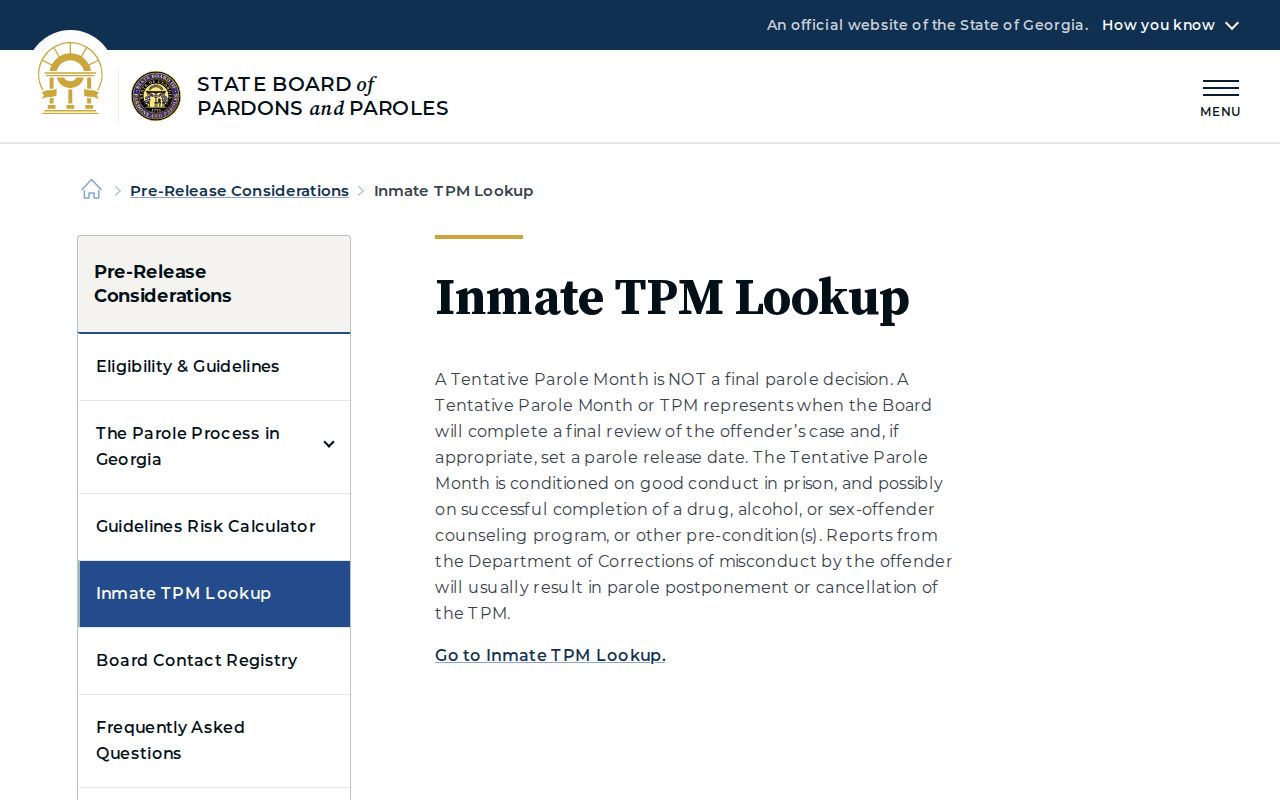
A TPM may change before release, while the parolee record and DCS office are better sources after parole begins.
Lanier Supervision Office Details
A useful local fact is that Lanier has a named DCS contact in Lakeland even though the location is listed as a virtual office. The DCS Lakeland location page says the office serves the Alapaha Circuit plus Atkinson, Berrien, Clinch, Cook, and Lanier counties. A virtual-office listing should not be read as a public walk-in counter. Call before trying to visit or deliver papers.
Georgia DCS, Lakeland Virtual OfficePO Box 633
Lakeland, GA 31635
Phone: 229-569-5051
Fax: 478-216-2154
Monday-Friday, 8:00 a.m.-4:30 p.m. Eastern
Coordinating Chief: Ryan Smith
Have the person's full name, date of birth if known, GDC ID, court case number, and the reason for the inquiry ready. Staff may limit what can be shared, but the office can help identify whether it is the right reporting location. For an immediate safety issue or an active warrant question, contact law enforcement rather than waiting on an online record.
The official DCS office listing provides the local supervision details.
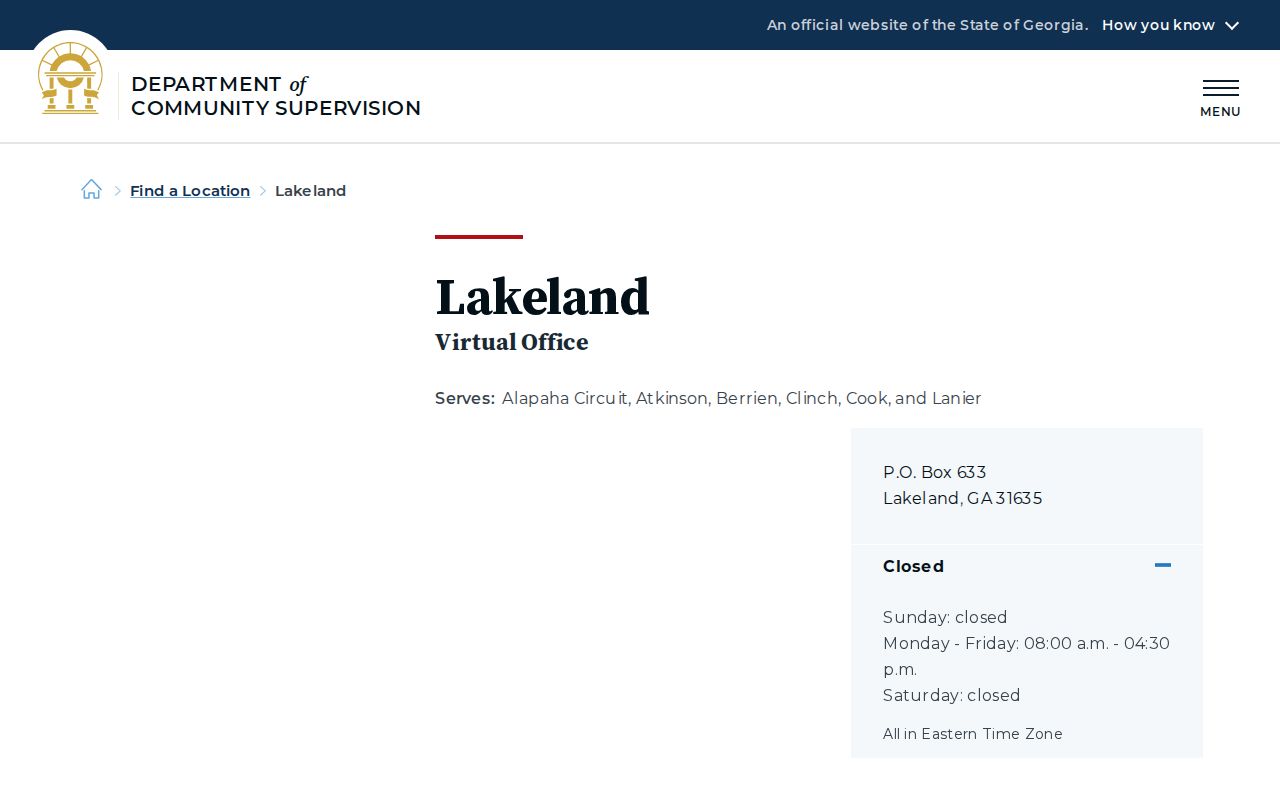
The listing ties Lanier County supervision to the Lakeland virtual office and states its service area, mailing address, hours, and phone.
Lanier Parole Meeting Distinction
Georgia's monthly public Board meetings are not hearings for individual Lanier County offenders. This distinction prevents a common search error. The Board posts meeting notices and press releases with a date, place, and open-meeting information. Those meetings address Board policy and operations. Official Board material states that offender cases are not considered and parole decisions are not made at those sessions.
Board members make parole decisions through daily case review. A person looking for one offender's outcome should use the TPM tool before release and the Parolee Database after release, not wait for a monthly meeting agenda. Supported outcomes include setting a TPM, denying parole, granting parole after final review, or reconsidering an earlier decision. The Board may also require completion of work release in some life-sentence cases. A majority vote is required for clemency action.
Eligibility is offense-specific. O.C.G.A. 42-9-45 supplies general rules, and the Board says many eligible inmates reach statutory eligibility after one-third of a sentence. That is not a promise of release. Serious violent felony categories, fourth-or-more felony recidivists, and life-without-parole cases can be excluded under the rules described by the Board. A TPM remains tentative until final review.
Lanier Supervision Violations
Supervision conditions come from the parole certificate, probation sentence, or later court and agency directions. They can address reporting, travel, treatment, fees, association, or other conduct. The exact order matters. A generic list cannot establish a particular person's rules. For probation, request the sentencing and revocation orders. For parole, verify the record through the Board and DCS.
The State Board's parolee search may include a wanted field. That is the best official online route found for parole wanted status. No Lanier-specific sheriff warrant list was found in the reviewed sources. If a record indicates wanted status, or if the person may have stopped reporting, confirm with DCS and the Lanier County Sheriff's Office. An absconder label concerns supervision compliance. It does not by itself explain the alleged violation, prove a new conviction, or show the final result of a revocation case.
A violation can lead to a warrant, arrest, administrative action, a court revocation hearing, or confinement at a place such as Patten PDC. The forum depends on parole versus probation. Check the later court or Board record because an old wanted flag may not reflect a resolved case.
Lanier Supervision Discharge Records
Release from a jail, discharge from supervision, and restriction of a record are separate events. Jail release ends one period of physical custody. Discharge ends the parole or probation term when the proper agency or court records it. Record restriction under O.C.G.A. 35-3-37 may later limit public criminal-history access when the legal requirements are met.
For parole, seek the Board or DCS record that confirms the supervision end date. For probation, obtain the discharge order or docket entry from the sentencing court. Georgia first-offender discharge can also affect how a case appears after completion, but it is not the same as the date someone left jail. The full local release-record path is explained on the Lanier County released inmates home page.