
Lanier Court Release Reasons
The Lanier County Sheriff's weekly Jail Media Report can place a person in its “BOOKED & RELEASED” group. That is useful proof that a local jail stay ended during the report period. It may not state the exact release time, destination, or full legal reason. The court docket often supplies the missing link. A docket is the court's chronological list of filings, hearings, and orders in a case.
A bond order may permit release while a charge remains open. A dismissal or nolle prosequi entry means the prosecution ended that charge without a trial judgment. “Time served” means custody already completed satisfies the confinement ordered. A sentencing order can impose probation, more confinement, a split sentence, or a state prison term. A transfer or hold can send the person to another custodian. None of those outcomes should be inferred merely because a name is absent from a current roster.
A court order explains the legal basis for release, while the jail or receiving agency confirms the person's physical custody status.
Choose the Lanier Release Court
Start with the case type and any number printed on the arrest, bond, citation, or jail record. Lanier Superior and Juvenile Court records are managed by the Clerk of Superior Court. Magistrate and Probate Court have their own local contacts and online docket routes. Sending a request to the wrong clerk adds delay and can produce a “not found” answer even though a record exists elsewhere.
| Lanier court path | Release-related records to seek | Access point |
|---|---|---|
| Superior Court | Indictment, felony bond, plea, sentence, probation, revocation, transfer, discharge | Superior Court clerk, GSCCCA listing, or PeachCourt search |
| Juvenile Court | Orders in a juvenile matter, subject to access limits | Superior/Juvenile clerk |
| Magistrate Court | Warrant, initial bond, preliminary case events, Magistrate docket | Magistrate clerk and Georgia Magistrate Records |
| Probate Court | Traffic dockets and other Probate matters | Probate clerk and Georgia Probate Records |
Juvenile, sealed, restricted, and some first-offender records may not appear through an ordinary public search. The lack of an online result does not establish that no case or release order exists. Ask the correct clerk what public docket information can be provided.
Lanier Superior Release Records
The GSCCCA Lanier County clerk listing identifies Patricia L. Bass as Clerk of Superior Court. The office is at 56 W Main St., Suite 5, Lakeland, GA 31635. Public hours are 8:00 a.m. to noon and 1:00 p.m. to 5:00 p.m., Monday through Friday. The phone is 229-482-3594 and the fax is 229-482-8333. The listing states that the clerk manages Superior and Juvenile courts.
For a criminal release question, ask for a docket sheet first. Then identify the exact order that ended or changed confinement. Useful terms include bond order, accusation, indictment, plea, sentencing order, jail-credit entry, probation order, revocation order, dismissal, and discharge. A case number is the best key. When it is unavailable, provide the full name and a narrow date range rather than a broad request.
The official clerk directory offers a visual check of the correct Lanier court office. Review the Lanier clerk result before using the contact details shown with it.
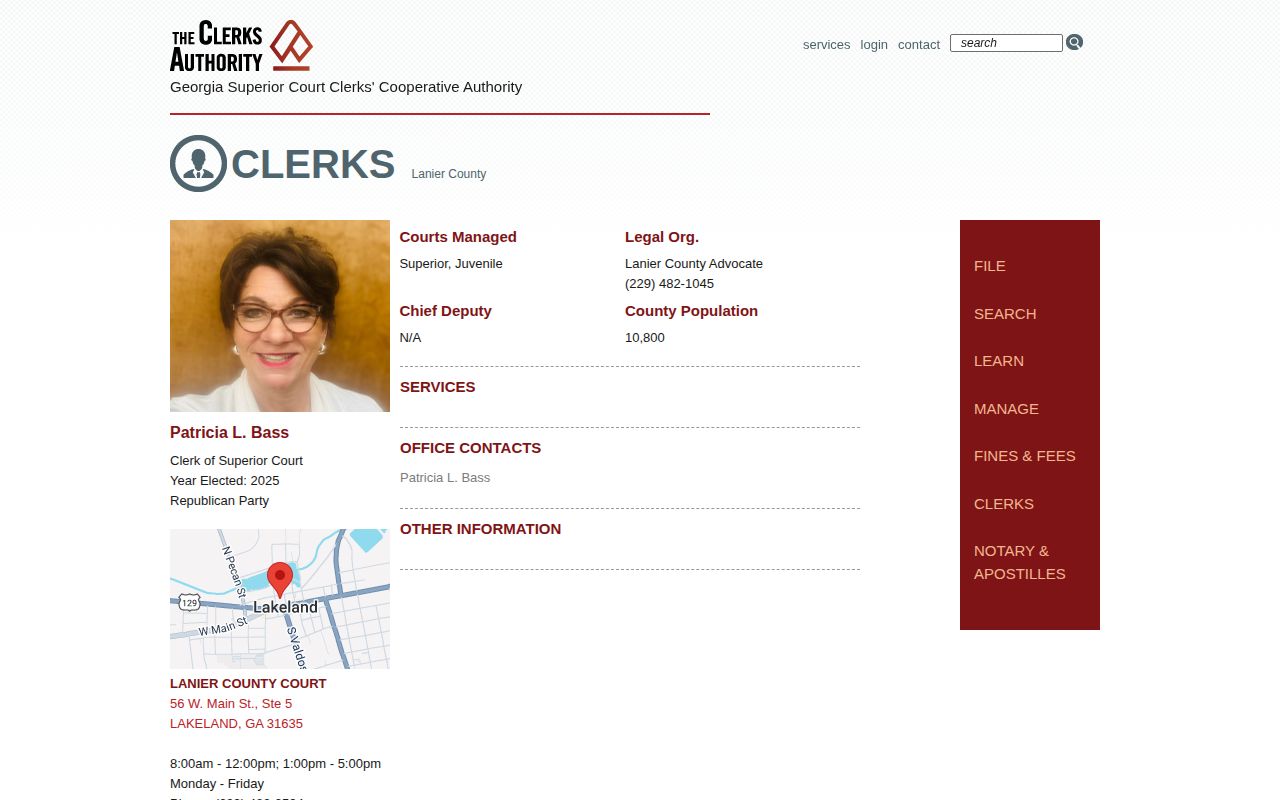
The source confirms the Superior and Juvenile routing point, which is separate from the Sheriff's custody report and the Magistrate and Probate office.
Lanier Magistrate Release Records
Lanier County's Magistrate and Probate courts are at 56 W Main Street, Suite 10, Lakeland, GA 31635. The county Probate and Magistrate Courts page lists 229-482-2207 for Magistrate Court, 229-482-3668 for Probate Court, and laniermag@laniercountyboc.com. Those contacts matter when the release followed an early bond decision, warrant proceeding, or court matter handled outside Superior Court.
The Lanier Probate Court services page routes publicly available Magistrate dockets and documents through Georgia Magistrate Records. It routes certain Probate and traffic dockets through Georgia Probate Records. Traffic payment is not the same task as finding a jail release order, so use the docket route that matches the case. Ask the clerk when the online portal does not expose the needed order.
- Bond order
- A court record setting security or terms that may permit release while a case continues.
- Recognizance
- Release based on a promise to appear, subject to conditions set by the court.
- Disposition
- The recorded outcome of a charge or case.
- Revocation
- A court action changing probation after an alleged violation.
- Discharge
- An order marking completion under the terms stated by the court.
Search Lanier Court Dispositions
Georgia Courts' E-Access to Court Records page directs users to a provider and notes that an account is required. PeachCourt supports civil and criminal case search after login. The portal route can be faster than a clerk request when the correct county, court, name, or case number is known, but access and document availability can vary.
- Read the jail, arrest, bond, or citation record for a case number and court name.
- Open the relevant court portal or contact the clerk that manages that court.
- Search Lanier County by case number first, then by party name if needed.
- Open the matching docket and compare the charge, filing date, and party details.
- Locate the bond, disposition, sentence, revocation, dismissal, or discharge entry.
- Request the public order from the clerk if the docket shows an entry but not the document.
Use the order date with care. A judge may sign or enter an order before jail staff complete processing. The docket establishes the legal act. The Sheriff's release record establishes when local physical custody ended. Comparing both records prevents a court date from being mistaken for the precise jail exit time.
Read Lanier Release Dispositions
A useful docket review follows the whole custody chain, not just the last entry. The arrest warrant, accusation, indictment, citation, or complaint identifies the matter. Bond entries show whether release was authorized and on what terms. Disposition and sentence entries explain what the court did with each charge. A later revocation or discharge can change the meaning of an earlier probation order.
| Docket entry | What it may explain |
|---|---|
| Bond order | Authority and conditions for release before final disposition |
| Dismissal or nolle prosequi | Why prosecution of a listed charge stopped |
| Plea or verdict | Basis for the sentence that followed |
| Sentencing order | Confinement, jail credit, probation, or state custody |
| Revocation order | Why probation led to confinement or a sanction |
| Completion or discharge | Whether the court recorded completion under that order |
| Transfer or hold notation | Why local custody ended without community release |
One case can contain more than one charge and outcome. A dismissed count does not erase a sentence on another count. Likewise, release on bond does not mean the case ended. Match each disposition to its charge and compare the case with the jail booking record.
Lanier Court Records Versus Rosters
A current jail roster answers a narrow question: who is shown in that custody system now. Lanier's public-facing source is a weekly Jail Media Report rather than a searchable daily county roster. Its “BOOKED & RELEASED” section can confirm a short stay during the stated week, while the docket can preserve the bond, disposition, or sentence long after the report rotates.
Thomas County also matters when an entry states “HOLD FOR LANIER CO” or “HOUSED FOR LANIER.” A release from Thomas physical custody may represent bond, return to Lanier, transfer, or clearance of the housing hold. For a state sentence or Patten Probation Detention Center stay, the Georgia Department of Corrections record becomes the custody source. Federal and immigration transfers require their own systems. The Lanier County released inmate search lays out those separate custody routes.
Released from one building can mean transfer to another agency. Confirm the destination before treating a roster change as community release.
Restricted Lanier Release Records
Georgia record restriction under O.C.G.A. 35-3-37 can limit what appears in public criminal-history channels after a qualifying disposition. First-offender treatment creates another distinction. O.C.G.A. 42-8-62 concerns transmission of first-offender sentence information, while O.C.G.A. 42-8-62.1 permits a person discharged and exonerated under the article to seek sealing of records identified by the law.
These rules do not make “released from jail,” “case completed,” and “record sealed” interchangeable. Release is a physical custody event. Disposition is the court's action on a case. Discharge can mark completion under an order. Restriction or sealing controls later access to certain information. A missing public docket may reflect lawful access limits, especially in juvenile, sealed, restricted, or first-offender matters. The clerk can explain record availability, though legal interpretation should come from a qualified Georgia attorney.
Confirm Lanier Court Release Records
Build a release confirmation from two matching records. First, obtain the court entry that states the legal outcome. Second, obtain the custody record that states when the person left and whether another agency received them. Ask the Lanier Sheriff's records custodian for the booking record, release date and time, release reason, bond details, and transfer-to agency when applicable. Ask the court clerk for the docket sheet and named order.
Names alone can produce false matches. Compare the case number, booking or inmate number, arrest date, charge, and court. If the order sends the person to GDC, use the state offender search rather than the county report for later custody and release. If it imposes felony probation or follows a state release, the Department of Community Supervision may hold the next public contact record. Court and custody sources answer different parts of the same event.
Public Record Search
Sponsored Results